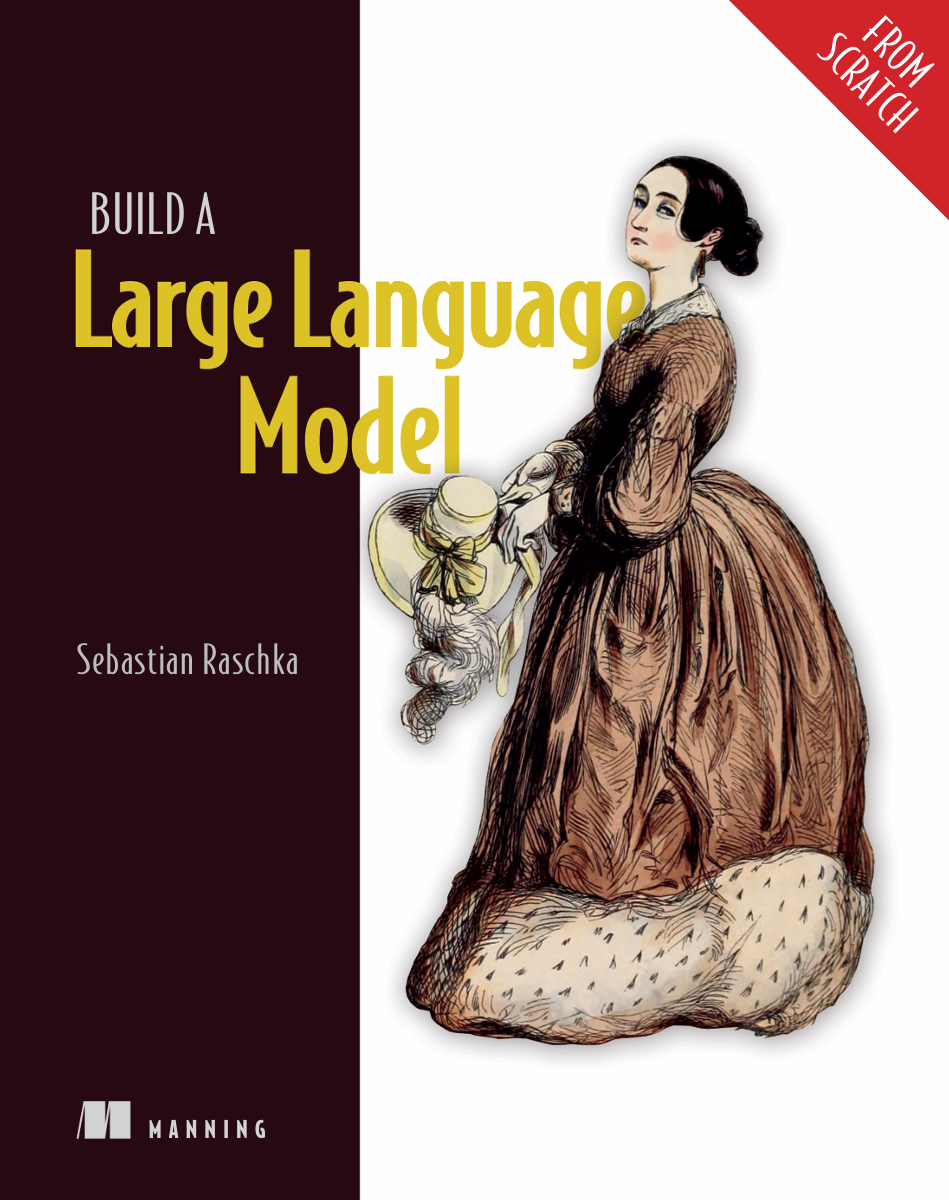
Brief Review
The first time I became interested in AI was at the end of 2024. At that time, I was trying to find a book that could explain how ChatGPT (the booming AI at the time) actually works. Interestingly, ChatGPT itself recommended this book to me.
When I started reading it, I really enjoyed the way Sebastian explained the concepts of large language models to someone like me, who at that time knew almost nothing about AI. The book helped me understand the basic ideas behind transformers, why the attention mechanism matters so much, how encoding and decoding work, the concept of embeddings, fine-tuning, and many other important parts of an LLM.
What I really like about this book is how clear the diagrams, explanations, and code examples are. It doesn’t only tell you theoretically how an LLM works (you actually build one step by step). There are also code repositories on GitHub that you can experiment with yourself, which made the learning process much more interesting for me.
You will also work a lot with PyTorch, which I think is one of the most important things to learn if you want to dive deeper into AI and deep learning. PyTorch is an open-source deep learning framework commonly used to build, train, and experiment with neural networks and other AI models. So, besides learning about LLMs, this book also gives you a good opportunity to build a stronger foundation in PyTorch.
The Target Readers
If you want to understand what is actually happening behind an LLM instead of only using ChatGPT or calling an API, I really recommend this book.
You will learn how an LLM works, how the pretraining process is done, how datasets are prepared and processed, how to fine-tune a model, and how to evaluate the results. You will also work on several projects provided in the book, and don’t worry the step-by-step code and explanations are already there to guide you.
Even if you’re still a beginner in AI or relatively new to coding, I think this book is still very relevant. Of course, having some basic Python knowledge will make the journey easier, but you don’t need to already be an AI expert before opening the first chapter.
For me, this was one of the books that helped turn AI from something that looked like a magic into something I could actually understand piece by piece.