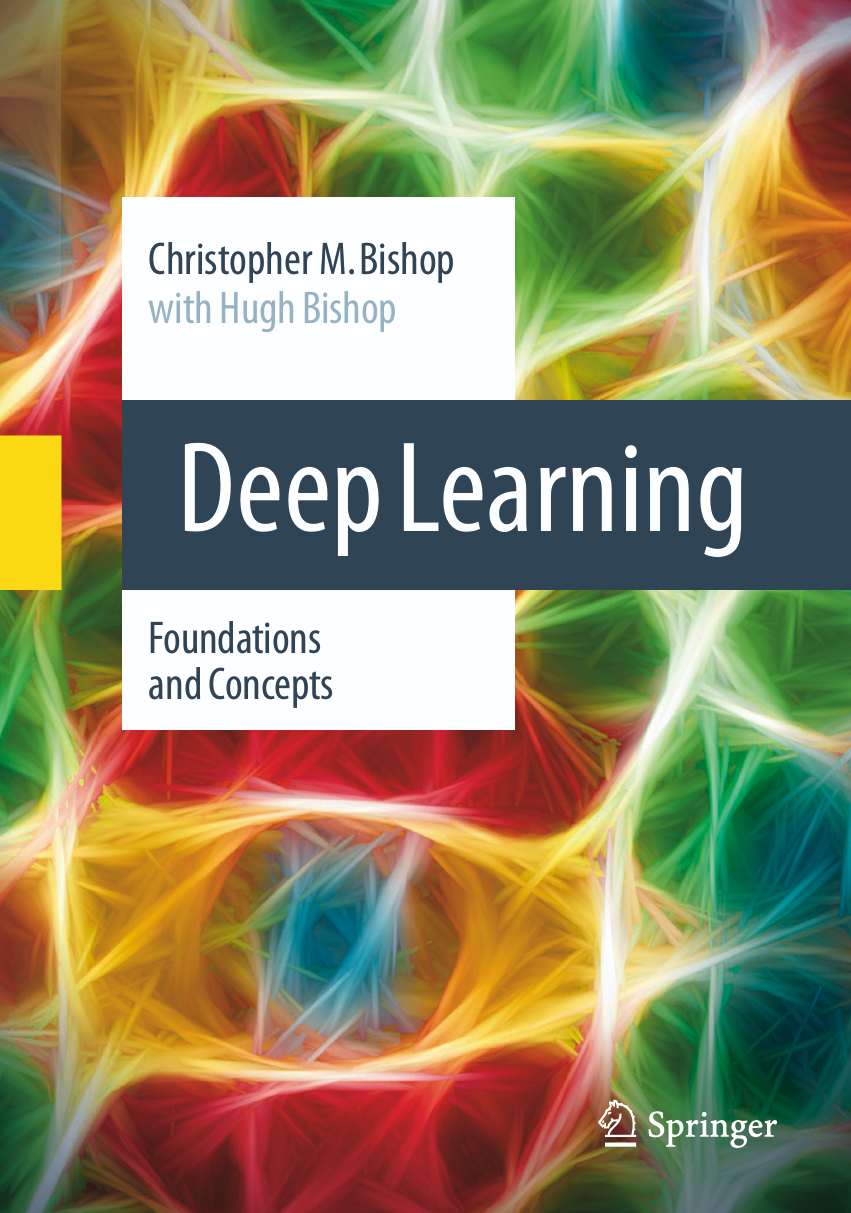
Brief Review
Here’s the book for you who wanna deep dive into the background architecture of AI. If Sebastian Raschka book is like the surface of ocean, this book allows you to deep dive into a 100m of the ocean. What does it means? Yeah, the background architecture used by AI is deep learning. Here, you’ll learn not only how to use neural network library from Pytorch, but why the methods actually work (math behind it). And math, is one of the reasons why I became interested in this book.
Christopher M. Bishop is already very well known name in machine learning, he’s a British computer scientist and the Director of Microsoft research AI for Science. I know him from his previous book, Pattern Recognition and Machine Learning (worth to read too). In this book, he focuses more specifically on deep learning and explains the math and conceptual foundations behind modern neural networks. What I really like about this book is that it does not treat deep learning as only a collection of architectures that you have to memorize. Instead, it tries to explain the concepts behind them. You will learn about neural networks, probability, optimization, backpropagation, regularization, convolutional networks, transformers, generative models, and many other important topics in modern deep learning.
Compared with more practical deep learning books, I think this one is more mathematical and theoretical. There are equations everywhere, and sometimes you need to stop for a while and think about what is actually happening. But for me, that is also the interesting part. The book tries to connect deep learning with probability theory, statistics, linear algebra, and optimization, so you can understand the reason behind the methods instead of only knowing how to implement them.
The diagrams and explanations are also very clear. Bishop has a good way of presenting complicated concepts step by step, especially when the topic involves probability or mathematical derivations. Some sections can still be difficult, but I think the difficulty comes more from the subject itself rather than from the way the book is written.
Another thing I like is that this book covers many concepts that are directly related to modern AI. Transformers and attention are discussed, but the book also goes beyond them. It gives you a broader understanding of deep learning as a field, including how models learn representations, how uncertainty can be handled, and how generative models work.
The Target Readers
I think this book is especially suitable for people who already know the basics of machine learning and want to understand deep learning at a deeper level.
If you only want to quickly train a neural network using PyTorch or TensorFlow, there are probably easier books for that purpose. But if you want to understand what happens behind the equations, why backpropagation works, why regularization is important, how probability appears in machine learning, or why certain architectures are designed in a particular way, then this book is very valuable.
You do not need to be a mathematician before reading it, but having some understanding of linear algebra, calculus, probability, and basic machine learning will help a lot. I personally would not recommend this as the very first AI book for someone who knows nothing about machine learning, because some parts can become overwhelming very quickly.
For me, this book is more like a bridge between using deep learning models and actually understanding the foundations behind them. It helps move deep learning from something that looks like a collection of powerful black-magic techniques into a subject that can be understood from its mathematical and conceptual foundations.