Brief Review
If Rocket Propulsion Elements by Sutton teaches you how rocket propulsion works, this is the book you open when you start asking:
“Okay, but how do I actually design the engine?”
For me, that is probably the easiest way to explain the difference between Sutton and Huzel. Sutton gives you a very strong foundation. You learn about thrust, specific impulse, chamber pressure, nozzle expansion, propellants, combustion, engine cycles, cooling, turbopumps, and many other important concepts. But eventually, when you actually try to design a liquid rocket engine, another problem appears. You know what a turbopump is. But how do you start designing one? You know what an injector does. But how should the injector actually be configured? You understand regenerative cooling. But how do you translate the heat transfer problem into an actual thrust chamber and cooling system?
This is where Huzel and Huang become really interesting. Basically every hobbiests or a serious rocket engineer have to read this book first.
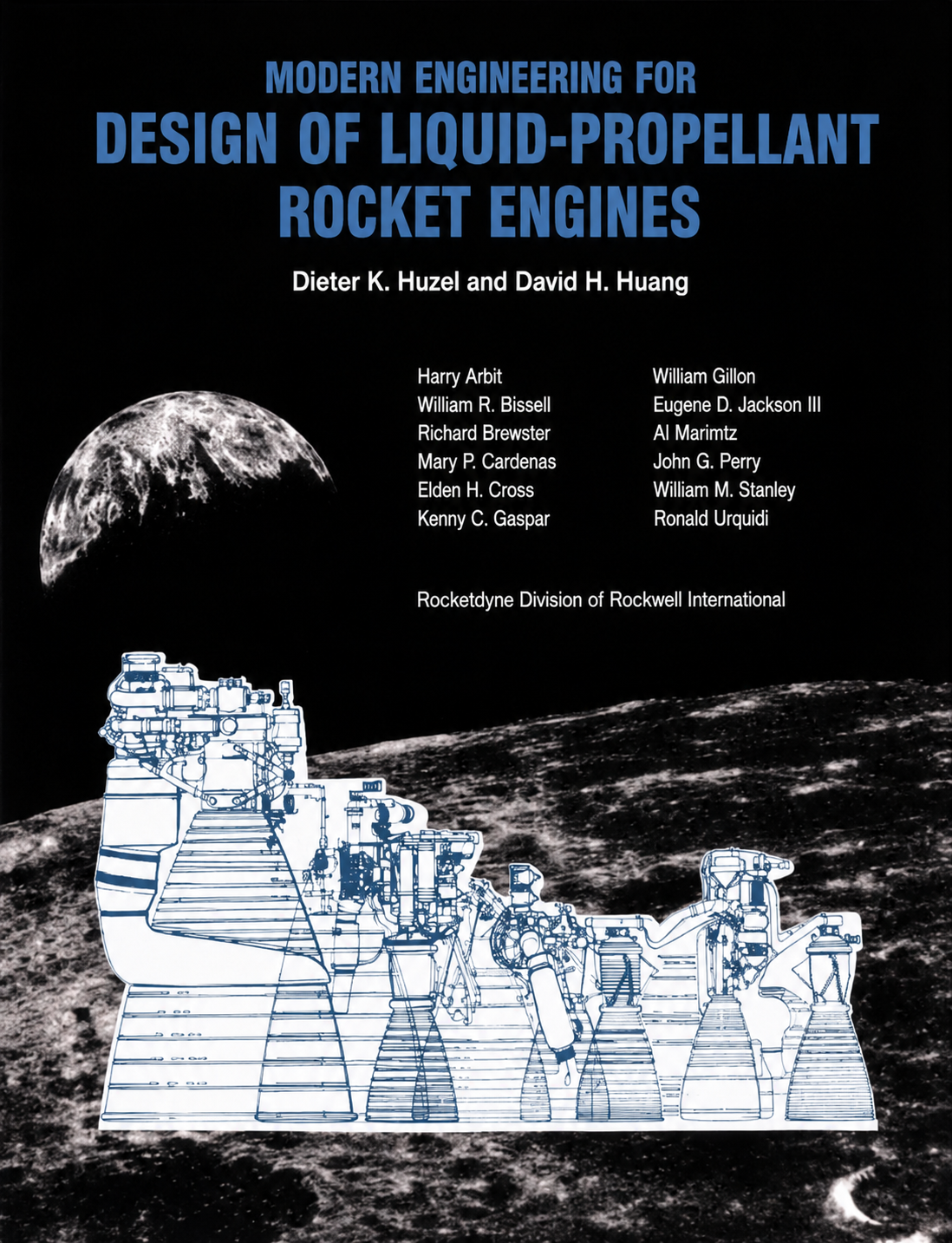
Some historical timeline of this book. The original Design of Liquid Propellant Rocket Engines was published as NASA SP-125, with its second edition appearing in 1971. The book was later revised, updated, and enlarged into the 1992 AIAA volume, with contributions from engineers from the Rocketdyne Division of Rockwell International. The intention was very practical: to bridge rocket propulsion fundamentals with the way liquid rocket engines are actually designed and developed. And you can really feel that when reading it. This book gives you an opportunity to know or to learn from the masters, the best in their field, and ofc I’ll not skip this one. I personally have read this book multiple times and still always get some new insight when I re read it. I also designed my 5000N methalox rocket engine because I read this book, if I didn’t I don’t know am I have the capability to do it.
This is not only a propulsion theory book anymore. It starts getting into the actual engineering of the hardware. You will go through the thrust chamber, injector, combustion devices, nozzle, cooling system, propellant feed system, turbopump system, valves, controls, structures, and eventually how those components interact as one complete engine system. The book moves from component design into subsystem design and finally into the complete engine. That system-level perspective is probably one of the things I like the most about this book. When you first learn rocket propulsion, it is very easy to study everything separately. Here is the injector, here is the combustion chamber, here is the turbopump, here is the nozzle. But a real rocket engine obviously does not work like that. Every design decision affects something else. Increase the chamber pressure and you may improve performance, but now your feed system has to deliver propellant at an even higher pressure. That affects your turbopump. The turbopump requires more power. That affects your turbine and engine cycle. Your chamber pressure and mixture ratio affect combustion temperature. That affects your cooling requirement. Your cooling requirement affects the regenerative cooling channels, pressure losses, material temperature, and eventually the pressure your pump has to provide again. Suddenly, everything becomes connected.
And I think this book does a really good job of making you realize that designing a rocket engine is basically a huge engineering compromise where thermodynamics, fluid mechanics, heat transfer, structures, materials, turbomachinery, combustion, and manufacturing all have to work together. Another thing I really like about this book is the amount of practical engineering information inside it. There are many diagrams, configuration drawings, tables, design relationships, parameter selections, and sample calculations. It feels much closer to an engineering handbook than a normal university textbook.
Instead of only telling you the principle behind a component, the book often continues into questions such as what configuration should be considered, which parameters dominate the design, what limitations appear, and how the component connects with the rest of the propulsion system.
And this becomes especially interesting in the turbopump sections. Turbopumps are probably one of the most complicated parts of a high-performance liquid rocket engine. Now you are dealing with pumps, turbines, shafts, bearings, seals, cavitation, rotational speed, pressure rise, efficiency, structural loads, and sometimes cryogenic fluids, all operating together. Huzel and Huang go much further into this engineering side than the introductory treatment you usually get from Sutton. The book’s contents specifically include turbopump system performance and turbopump system design parameters, together with the other major engine components such as valves.
The thrust chamber section is also one of the most valuable parts of the book for me. You start connecting combustion chamber geometry, injector design, nozzle design, heat transfer, cooling, pressure losses, and structural requirements. Again, you are no longer looking at the thrust chamber as simply a place where propellants burn. You start seeing it as an actual piece of hardware that somehow has to survive an extremely hostile thermal and mechanical environment while still producing the performance you calculated on paper.
That transition from physics to components implementation is probably what defines this book. There is one funny problem, especially if you grew up using SI units like me.
Imperial units. Everywhere. LoL
You will meet psi, inches, pounds, feet, BTU, and other units that may force you to keep a unit converter nearby. Readers still regularly point this out when working through the book. It can be annoying, but I do not think it reduces the value of the engineering itself. There is also another limitation that naturally comes from the age of the book.
The design philosophy comes largely from the generation of American liquid rocket engine development that produced engines such as those from Rocketdyne. The AIAA edition was published in 1992, so obviously it predates many things that have become normal in modern propulsion engineering today.
Today, we have high-fidelity CFD, conjugate heat transfer simulation, advanced optimization methods, much more powerful structural analysis, modern combustion modeling, and additive manufacturing that can produce regenerative cooling geometries that would have been extremely difficult to manufacture several decades ago.
So I would not use Huzel as the only source for designing a modern engine.
But I think that actually makes the book more interesting rather than less useful. You will learn the system design, components, and how they related each others.
The Target Readers
I would strongly recommend reading Sutton first.
If you still do not understand chamber pressure, mixture ratio, specific impulse, characteristic velocity, nozzle expansion, engine cycles, or the basic architecture of a liquid rocket engine, Rocket Propulsion Elements is probably the better place to start.
But once those concepts already make sense and you start asking:
“How do I actually turn this into an engine?”
Then I think Huzel and Huang should be one of your next books. This book is especially suitable for aerospace or mechanical engineering students who want to specialize in propulsion, researchers entering liquid rocket propulsion, and engineers who want to move from general rocket theory into component and system design. You should already be comfortable with thermodynamics, fluid mechanics, heat transfer, basic structural mechanics, and preferably compressible flow. Some understanding of turbomachinery will also help a lot once you reach the pump and turbine sections. I would also say this book is much more relevant for someone who wants to become a rocket propulsion engineer than for someone who is only casually interested in rockets. Because at this point you are not only learning why rockets work, you are learning how engineers actually think about building one.