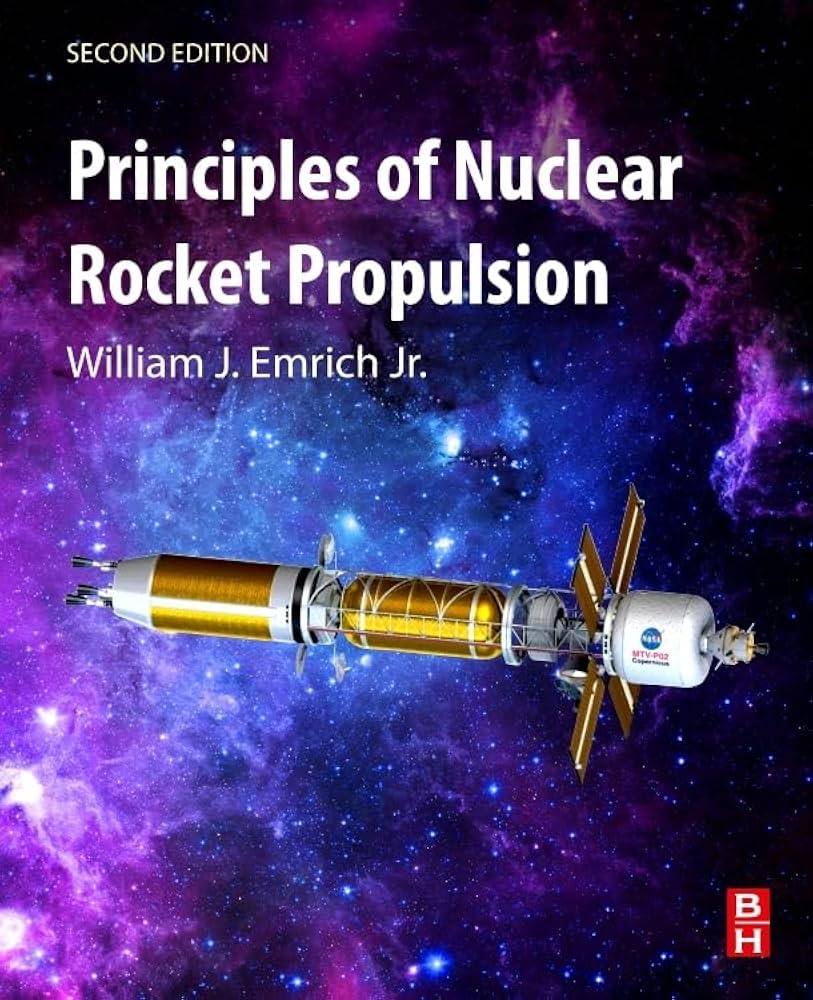
Brief Review
Okay, now we move from chemical rockets into something much more unusual: nuclear rocket propulsion. I think you should enjoy with quantum mechanics, nuclear physics, and particle physics first before you wanna read this book. I did, because I basically love physics, I’ve learn quantum mechanics and particle physics since high school.
This book introduces a completely different question: What if we don’t need combustion at all? That is basically where nuclear thermal propulsion starts. In a conventional chemical rocket, you mix fuel and oxidizer, burn them inside the combustion chamber, produce extremely hot gas, and expand that gas through a nozzle to generate thrust. In a nuclear thermal rocket, the basic idea is different. There is no combustion between fuel and oxidizer. Instead, a nuclear reactor becomes the heat source. A propellant, usually something with a very low molecular weight such as hydrogen, passes through the reactor, absorbs an enormous amount of thermal energy, becomes extremely hot, and then expands through a rocket nozzle to produce thrust. Instead of chemistry, now you have nuclear fission.
Emrich actually wrote the book because he encountered this exact problem while teaching. He started teaching a nuclear rocket propulsion course at the University of Alabama in Huntsville in 2006 and realized that there was no textbook that properly combined rocket propulsion and nuclear reactor theory into one subject. So he eventually wrote one. Emrich also spent his career working on nuclear thermal propulsion research at NASA Marshall Space Flight Center, including developing the Nuclear Thermal Rocket Element Environmental Simulator. So, absolutely he’s one of the best here.
And I think you can feel that combination throughout the book. The beginning is relatively familiar if you already read Sutton. You start with rocket engine fundamentals, Thrust, Specific impulse, Mass flow, nozzle expansion, rocket performance. Then you move into nuclear rocket engine cycles and start seeing how familiar rocket components can be connected with a nuclear reactor. The book also discusses interplanetary mission analysis, which is important because the whole reason nuclear thermal propulsion becomes interesting is not simply because putting a reactor inside a rocket sounds cool. It is because nuclear propulsion can potentially provide a very attractive combination of relatively high thrust and much higher specific impulse than conventional chemical propulsion. NASA has historically described nuclear thermal propulsion as capable of roughly twice the specific impulse of high-performance chemical systems.
After the rocket fundamentals, the book starts going somewhere that Sutton obviously does not: Nuclear physics. You begin with nuclear structure and nuclear processes, then neutrons, then neutron energy distributions, then neutron balance, neutron transport theory, multigroup neutron diffusion equation, and at this point you realize: Am I lost?
You are basically learning enough reactor physics to understand why a nuclear rocket reactor can work. That is probably one of the parts I like most about this book. When people hear “nuclear rocket,” it is easy to imagine that someone simply replaces a combustion chamber with a reactor and everything else works normally. Obviously, it is much more complicated than that. The reactor has to maintain a controlled fission chain reaction. Neutrons produced during fission have to interact with the fuel, some neutrons escape, some are absorbed, some cause another fission event, their energy distribution matters, the geometry of the reactor matters, the nuclear material matters. And somehow all of this needs to produce a stable and controllable amount of thermal power while a huge amount of propellant flows through the reactor. That is why Emrich spends so much time on neutron transport and diffusion.
This book answer the question:
“How do I make the reactor generate that heat in a controlled way?”
Then comes another really interesting connection: thermal-fluid engineering. Now the nuclear physics has to connect back to propulsion. The reactor generates thermal energy, but that energy needs to be transferred into the propellant. So heat transfer, fluid mechanics, pressure losses, material temperature, mass flow, reactor geometry, and propellant properties suddenly become coupled together. This is where the book starts feeling much more like aerospace engineering again. The propellant needs to move through extremely hot reactor passages, receive enough thermal energy, leave the reactor at the required temperature, and eventually expand through the nozzle.
And there is a fundamental reason why hydrogen becomes so attractive here. Rocket performance strongly benefits from a low molecular-weight exhaust. If you can heat hydrogen to an extremely high temperature without needing to carry an oxidizer and then expand it through a nozzle, you can achieve a very high exhaust velocity. That is one of the beautiful ideas behind nuclear thermal propulsion. You are basically separating two things that chemical rockets normally combine: energy generation and reaction mass. In a chemical rocket, your propellants provide both. They contain the chemical energy, and after combustion they also become the exhaust. In a nuclear thermal rocket, the reactor provides the energy while the hydrogen mainly acts as the working fluid and reaction mass. That difference changes the whole propulsion architecture.
The book also covers turbomachinery, which is something I really appreciate because a nuclear thermal rocket is still a rocket engine. You still have to move a huge amount of propellant. You still need pressure. You still have pumps, turbines, flow passages, pressure losses, and engine cycles. So even after spending chapters inside particle physics, suddenly you are back discussing turbomachinery again.
But then Emrich takes you back into another subject that is extremely important for nuclear systems: reactor kinetics. A reactor is not simply an ON/OFF heat source,its power changes dynamically. Neutron populations change. Control mechanisms affect reactivity. The reactor has startup behavior. It has transient behavior. Temperature changes can feed back into reactor behavior. And because this reactor is connected to a propulsion system, changes in propellant flow and temperature can also interact with the reactor. This eventually leads into nuclear rocket stability, another topic that I find really interesting.
The second edition goes further into these subjects, adding material on nuclear rocket startup, reactor stability, new fuel forms, advanced reactor concepts, and expanded coverage of other advanced propulsion ideas including fusion and antimatter propulsion. But the primary emphasis remains nuclear fission-based rocket engines, particularly nuclear thermal propulsion. Then there are two subjects that remind you very quickly that nuclear propulsion has engineering problems chemical rockets simply do not have: fuel burnup and radiation shielding. Now you need to think about what happens to the nuclear fuel over time. How does its composition change? What happens as fission products accumulate? What happens to reactor performance? And then there is radiation. Obviously, if you put a nuclear reactor inside a spacecraft, you cannot pretend radiation does not exist. You need to understand shielding, radiation exposure, geometry, mass penalties, and how the reactor interacts with the rest of the vehicle. And this is another thing that makes nuclear propulsion fascinating from a system engineering perspective. Adding shielding improves radiation protection. But shielding has mass. Mass affects vehicle performance. Vehicle performance affects mission capability.
So again, just like almost everything in aerospace engineering: there is no free lunch (Kecuali MBG).
The Target Readers
I definitely would not recommend this as your first rocket propulsion book. Again, I would start with Sutton. You should already understand thrust, specific impulse, nozzle flow, mass flow rate, thermodynamics, compressible flow, and the basic operation of a rocket engine before coming here. But interestingly, I do not think you necessarily need to be a nuclear engineer, just know some small concept there before opening this book is enough.
That is actually one of its strengths.
The book was written specifically to bring rocket propulsion and nuclear reactor theory together, and Emrich introduces the nuclear concepts needed to understand the propulsion system instead of simply assuming that every reader already has a nuclear engineering degree.
Of course, the deeper you go, the more mathematics and physics you will encounter. A good background in calculus, differential equations, thermodynamics, heat transfer, fluid mechanics, quantum mechanics, nuclear physics, and compressible flow will help a lot.
I think this book is especially suitable for aerospace engineering students who already understand conventional propulsion and want to explore advanced propulsion, nuclear engineering students who want to understand space applications of reactors, propulsion researchers, and anyone seriously interested in nuclear thermal propulsion.