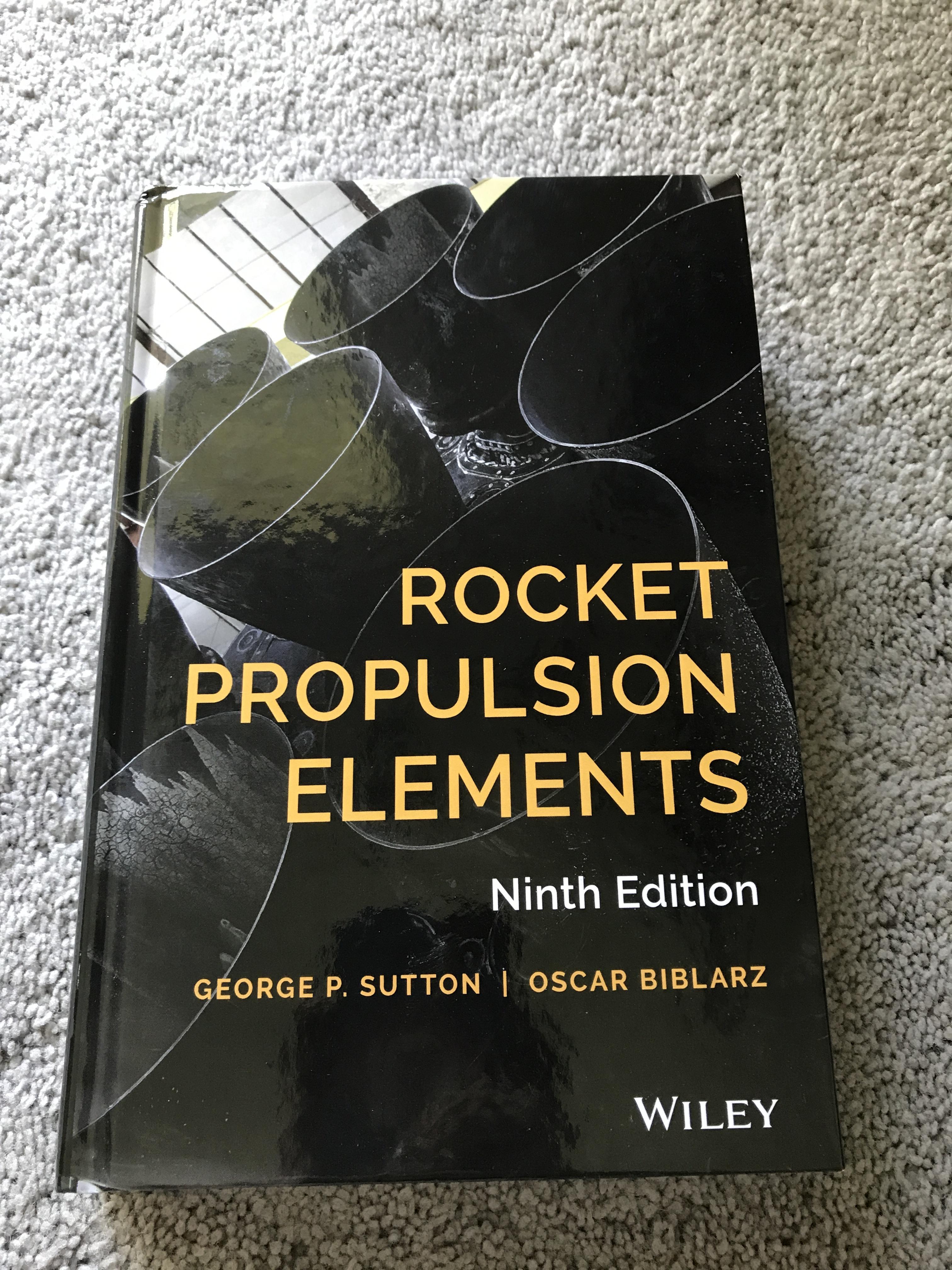
Brief Review
My dream :’),, ahh Ok, you read this one? Lets talked about this book. Definetly, this book is sooooo recommended. That’s all. You have to read it!!, especially you, the rocket science guy.
Basically, if you are interested in rockets, and what to understand what is actually happening inside a propulsion system of a rocket, this is one of the best starting point. This book probably one of the most well-known introductory books in rocket propulsion engineering, and for a good reason. It gives you the big picture first, but still goes deep enough into the engineering and physics behind the system.
When people see a rocket engine, usually the first thing they notice is the flame, diamond shocks, the bell nozzle, or simply the enormous amount of thrust it produces. But behind that, there are so many things happening at the same time: thermodynamics, compressible flow, combustion, heat transfer, fluid mechanics, turbomachinery, structural limitations, propellant chemistry, and control systems. All of those things have to considered, calculated, and checked many many times until the smallest precision you could. This book helps connect all of those things together.
One of the first important concepts you will learn is rocket performance. You will meet terms such as thrust, specific impulse, characteristic velocity, thrust coefficient, mass flow rate, chamber pressure, expansion ratio, and nozzle efficiency. These are probably some of the most fundamental quantities in rocket propulsion, and once you understand them, you start looking at a rocket engine very differently. For example, thrust is not simply “how powerful the engine is.” You start understanding that it depends on mass flow, exhaust velocity, pressure difference at the nozzle exit, and atmospheric conditions. Specific impulse also becomes much more meaningful because it tells you how effectively the propulsion system uses its propellant.
Then you move into one of the most important components in almost every chemical rocket engine: the nozzle. The book explains compressible flow through converging-diverging nozzles, choking, Mach number, expansion, pressure ratios, and how the nozzle converts thermal energy inside the combustion chamber into kinetic energy in the exhaust. This is one of those topics where thermodynamics suddenly becomes very physical. You calculate something on paper, such as chamber pressure, exit pressure, or expansion ratio, and then you can directly relate it to the actual geometry of a rocket nozzle.
The book also gives a broad treatment of different propulsion systems. You will encounter solid rocket motors, liquid propellant rocket engines, hybrid rockets, and other propulsion concepts. This is very useful because you begin to understand that there is no universally “best” rocket propulsion system.
Every architecture is a trade-off. Solid rockets are mechanically simpler and can provide very high thrust, but controlling or shutting them down is much more difficult. Liquid engines are more complicated because you need tanks, valves, injectors, feed systems, and sometimes turbopumps, but they give you much greater control over the engine. Hybrid systems sit somewhere in between and introduce their own advantages and limitations. The liquid rocket engine sections are probably among the most interesting parts for me. You will learn about propellant combinations, combustion chambers, injectors, propellant feed systems, pressurization systems, turbopumps, valves, cooling methods, ignition, and engine cycles. at this point, a rocket engine stops looking like only a combustion chamber with a nozzle attached to it. You start seeing it as an entire interconnected fluid and thermodynamic system. The injector has to atomize and mix the propellants properly. The combustion chamber has to maintain stable combustion while operating at extremely high temperature and pressure. If it unstable, what next step you can take? Add a baffle? Change the injector type, Or something else? The cooling system has to prevent the chamber wall from melting, film cooling, regenerative cooling, ablative technique, etc. The feed system has to deliver the required mass flow against chamber pressure. And if you are using a turbopump-fed engine, now you also need turbines and pumps operating at extremely high rotational speeds while handling cryogenic or chemically aggressive fluids. Everything affects everything else with almost 0 error tolerance.
Another thing I really like about this book is that it introduces you to the engineering calculations used during preliminary rocket engine design. Ofc, its not that complicated, even I think this is a high school student math. You can start from basic requirements such as thrust and chamber pressure, calculate the required propellant mass flow, estimate nozzle dimensions, evaluate engine performance, compare different propellants, and understand the trade-offs between different configurations.
Of course, the book will not suddenly make you capable of designing a flight-ready rocket engine from beginning to end. Real rocket engine development goes much deeper into combustion instability, detailed injector design, regenerative cooling, turbomachinery, materials, manufacturing, CFD, testing, and many other fields. But Sutton gives you the framework that connects all of those subjects. That is probably why I think the word Elements in the title is very appropriate. The book gives you the fundamental elements you need before you start specializing in one particular part of rocket propulsion.
The Target Readers
If you are an aerospace engineering student and want to learn rocket propulsion, I think this book should be one of your starting points. It is also very useful for mechanical engineering students, propulsion enthusiasts, researchers entering the rocket field, or anyone who already understands basic engineering physics and wants a serious introduction to how rocket propulsion systems work. You should have some background in thermodynamics, fluid mechanics, calculus, and preferably compressible flow. You can still read it without mastering all of those subjects, but some sections will become much easier if you already understand concepts such as conservation of mass, energy equations, pressure, temperature, Mach number, and basic gas dynamics.
If you only want to know why rockets can fly or how SpaceX launches work, there are much lighter books for that. Sutton is already an engineering textbook. You will find equations, performance calculations, thermodynamic relationships, engine diagrams, and actual design considerations throughout the book. But at the same time, I would not call it an extremely specialized propulsion book either. That is what makes it such a good starting point. It gives you enough depth to understand the engineering, but still covers the entire propulsion system instead of focusing on only one narrow subject. If later you want to study things like injector atomization, combustion instability, regenerative cooling, turbopump design, or detailed combustion chemistry, you will probably need other books and research papers.