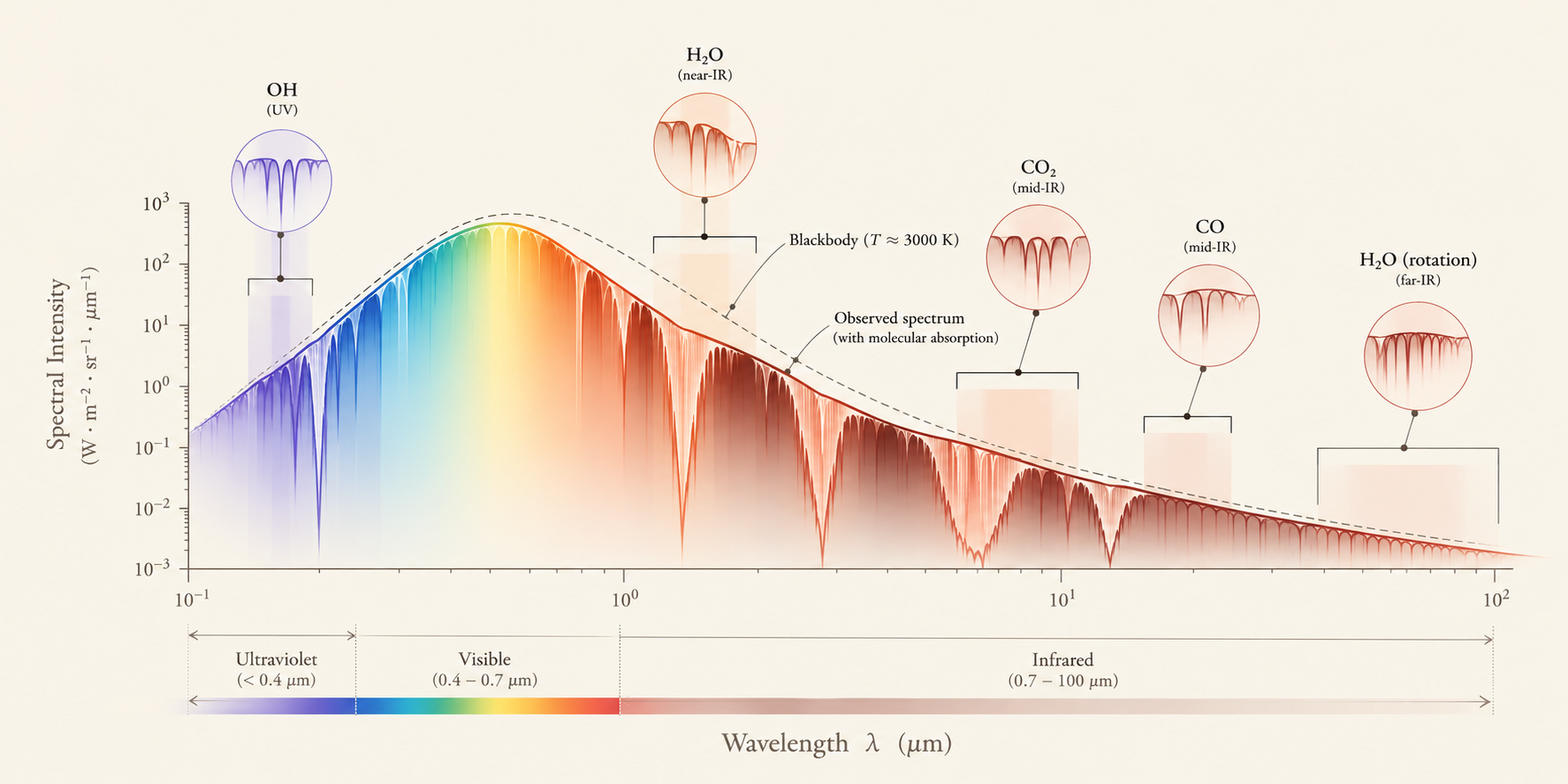
So, I created a program for structural and thermal analysis. I think I’ve talked about this in my previous post in the work section, especially my 5kN rocket engine project. I also said that the program has some mismatch with the CFD simulation. Then, I found research about radiation in the rocket engine. This research is soo cool, I think, and covers so many things about radiation in the rocket engine. This is doctoral research by Marco Fabiani. In his doctoral thesis, Fabiani concludes that thermal radiation is a fundamental and non-negligible contributor to the overall thermal environment in rocket propulsion systems, often accounting for 10% to over 30% of total heat loads depending on the engine concept.
He states that in the liquid rocket engine (LRE), radiative emission is overwhelmingly governed by and , whereas CO plays a negligible role. Radiative heat fluxes peak near the end of the cylindrical section of the combustion chamber and contribute up to 10% of the total heating power.
In my program, I found that my program produces around 12% error in the heat flux and structural thermal condition (underprediction). This matches what Fabiani found. I didn’t account for the radiation phenomenon and only considered conductive and convective heat transfer, including boundary condition calculations using the Bartz equation. Then, I decided to use what Fabiani developed in his research. He uses a new WSGG model that is usable for more extreme conditions that a standard gray-gas model fails to capture. He combines WSGG with DTM (discrete transfer method) to solve for 3D ray directions through the chamber. WSGG calculates the radiation by replacing millions of real spectral lines with just 4 fake gases + a transparent window. This makes the calculation much faster while still preserving its accuracy.
I’ll implement this method in my program, and I think this is the missing puzzle piece in my program. I’ll update the result in my work when it’s finished.
Reference
Marco Fabiani, Mario Tindaro Migliorino, Daniele Bianchi, and Francesco Nasuti. “Spectral and Global Radiative Heat Transfer Models for Liquid Propellant Rocket Engines.” Journal of Propulsion and Power, 2025.