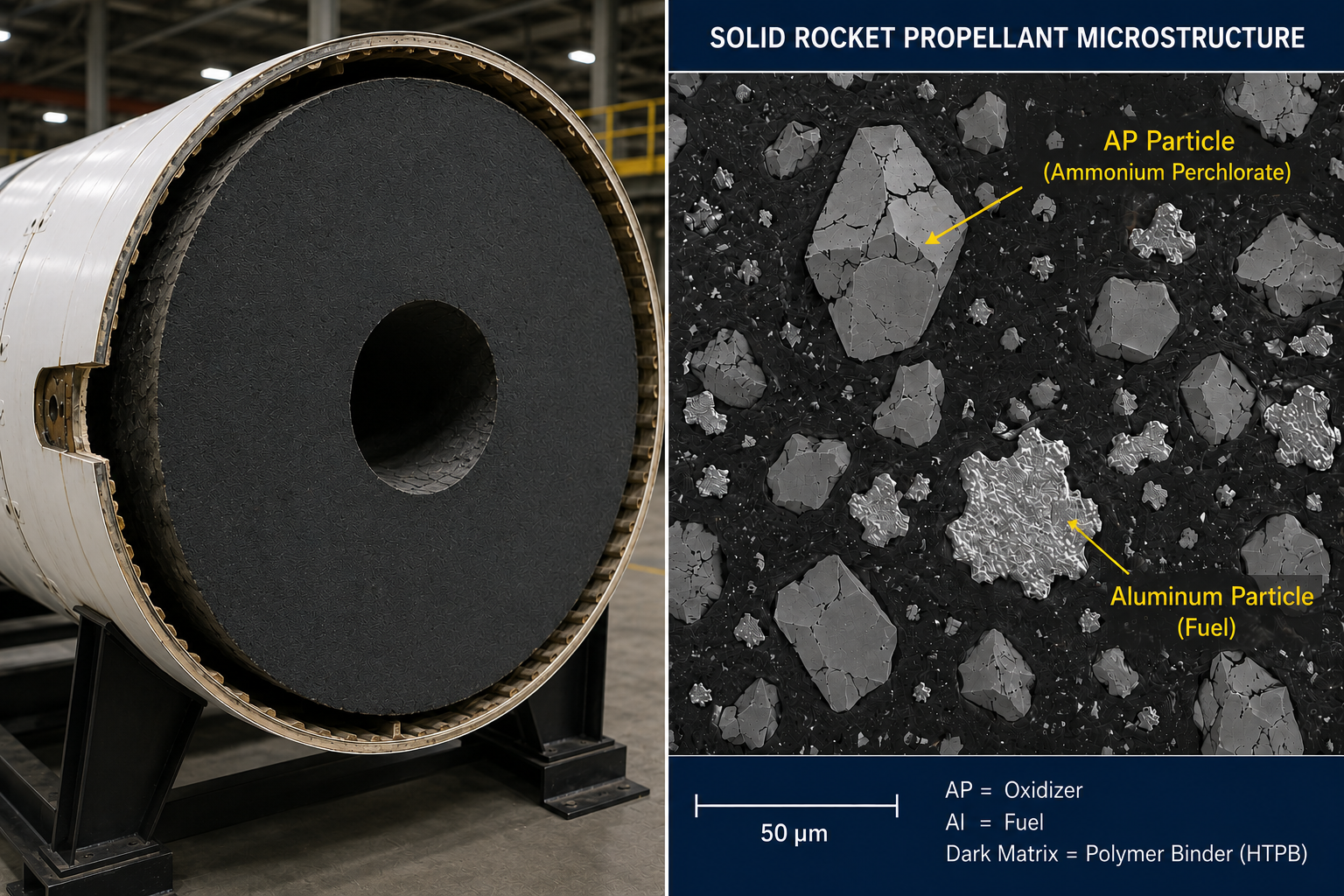
So, if we’re talking about rocket engines, we know that we have 2 different types of rocket engines based on their propellant phase, which are solid and liquid. I just wanna share some of my knowledge about solid rocket propellant here. So, please just treat this as a “quite deep” explanation about solid propellant(?) but do not rely only on this post and then you feel like you’re mastering solid rocket propulsion. No, it’s just not like that. There are so many things I skipped in this explanation, and you have to try to find them from other sources. But I guarantee you that this article is worth reading, especially if you’ve just gotten started learning about solid rocket propellant.
One of the most common views from people about SRM (stands for solid rocket motor) is that: it’s simple. Eeeee, basically not, I mean, yeah it’s simpler compared to a liquid rocket engine because you don’t need to design an injector, piping, regenerative cooling channel, turbopump, etc, but believe me, it’s not as simple as you think. It’s still a hard engineering field. So, before we deep dive into the technology behind SRM, I just wanna say a name.
Ammonium Perchlorate Composite Materials (APCP): this name literally explains so many things behind the SRM technology. So, APCP is a high-performance solid rocket propellant used in aerospace applications. Ofc, there are other composite materials such as ammonium nitrate, potassium nitrate, etc. But the highest performance, structural safety, and manufacturing predictability fall into Ammonium Perchlorate.
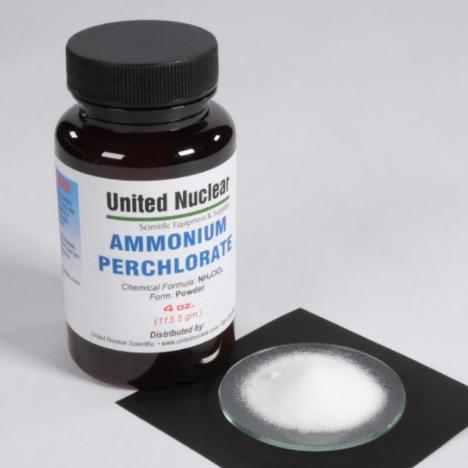
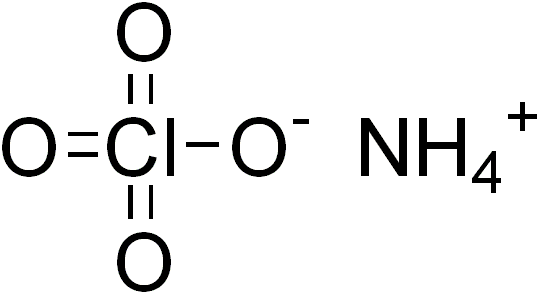
So, ammonium perchlorate () is only one ingredient in APCP. In fact, APCP (depending on the mixture) can contain 7 or more ingredients inside it. All of these ingredients have their own functionality in the construction of propellant. So, treat APCP as propellant, not just as a single chemical compound. And it’s not as simple as “ammonium perchlorate is the oxidizer and aluminum is the fuel”, no, believe me, if your propellant only contains these 2 materials, your rocket will not fire. So, don’t skip this; this is the most interesting part.
Some other materials in APCP include: binder, plasticizer, and curative material. The binder act as a fuel (next to the binder itself), the curative decides whether the grain behaves like rubber or brittle plastic, the plasticizer used to ensure that a highly filled slurry can move at all.
 a
a
 b
b
After you read this “short” article, you will understand about each component in APCP and about “what is AP, why do we use Al, why HTPB?” And you’ll also know about IPDI (stand for Isophorone Diisocyanete), MDI (methylene diphenyl diisocyanete), IDP (isodecyl pelargonate), and DOS (dioctyl sebucate). Please write down these hard chemical names before you continue because I will only use the acronym later.
The Composite Materials
First, we have to understand about the composite material. The cleanest model is concrete (Just imagine it). AP and aluminum are the aggregate. The polymeric binder is the cement, except this cement also burns. The curative builds the three-dimensional polymer network, and the plasticizer sits between polymer chains so the mixture can be processed and the cured grain can remain flexible.
Each components need to be set so that the proportion is fit. The exact mass fractions, particle distributions, additives, and processing window are design variables. The table below shows which ingredients deserve a chemical equation and which ones are more important through mechanics or processing.
Table 1. Ingredients and their primary job
| Ingredient | Primary job | Before ignition | During combustion |
|---|---|---|---|
| Ammonium perchlorate (AP) | Oxidizer | Dispersed crystalline solid; no intended reaction during storage. | Decomposes and supplies oxygen-bearing/chlorine-bearing species; controls much of the surface flame chemistry. |
| Aluminum | Metal fuel | Dispersed particles with an oxide shell. | Heats, melts, ignites, and forms mostly alumina; adds energy but also condensed-phase losses and slag risk. |
| HTPB | Binder and hydrocarbon fuel | Its hydroxyl ends react with a diisocyanate to form a polyurethane network. | Pyrolyzes to smaller hydrocarbons that burn with AP-derived oxidizing species. |
| IPDI or MDI | Curative | Builds the urethane network and sets pot life, cross-link density, and final mechanics. | A small contributor to the elemental balance; its largest influence is indirect through grain integrity and binder chemistry. |
| IDP or DOS | Plasticizer | Mostly remains physically dissolved in the binder; lowers viscosity and glass-transition behavior. | Vaporizes/pyrolyzes and joins the fuel pool. It changes the element balance slightly but is not the main oxidizer-fuel reaction. |
| Catalyst / bonding agent / surfactant | Control additives | Tunes cure, particle wetting, adhesion, or rheology. | Can alter decomposition or burning behavior even at low concentration, depending on chemistry. |
This distinction matters. The cure reaction happens slowly before the motor ever fire. The propellant combustion happens in milliseconds at the regressing surface. Mixing those two stages into one equation makes both of them harder to understand.
Polyurethane Network
HTPB (hydroxyl-terminated polybutadiene) is a polybutadiene network with hydroxyl groups at the ends. HTPB also has functionality distribution, so it behaves as a network-forming prepolymer.
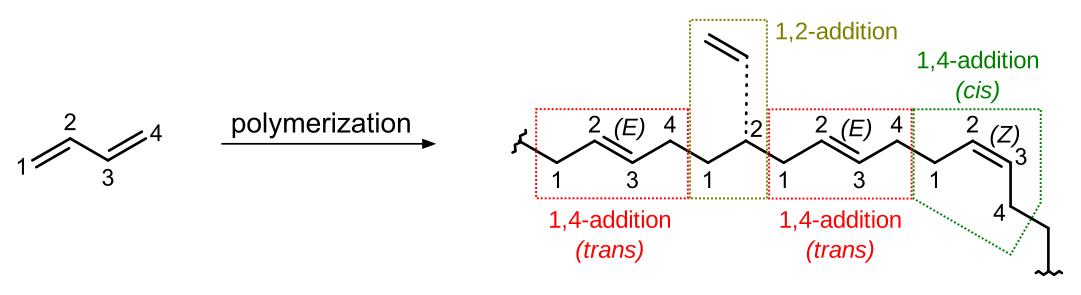
Figure 2. HTPB chemical compound.
In the simple way, chemical compound of HTPB is something like this:
The key cure reaction is between an alcohol group from HTPB and an isocyanate group from the curative. The new bond is a urethane linkage. Because a diisocyanate has two isocyanate groups and HTPB molecules have multiple reactive hydroxyl sites across the batch, this reaction ties many chains together.
You might realize that in the HTPB chemical compound, one component that really bound is OH, OH here is so important for the curing process. (btw R is the long chain of HTPB itself and R’ is the molecular core of the isocyanates, basically the curing agent/the hardener like IPDI or MDI) Without it, the HTPB would just stay a thick, unreactive liquid oil. Because the HTPB molecule has -OH groups attached to its ends (and scattered across the batch), it allows the chemical reaction to lock everything into place:
By reacting the -OH from R with the -NCO from R’, the molecules build a massive, interconnected 3D net called a polyurethane matrix. This chemical “net” transforms the rocket fuel from a pourable liquid sludge into a tough, synthetic rubber that can withstand the violent forces of a rocket launch.
Here, at least I wanna share about 2 curative materials: IPDI and MDI. IPDI is isophorone diisocyanate, a cycloaliphatic diisocyanate. Its molecular formula is:
In practical HTPB systems its main attraction is not a different combustion product; it is the relatively slow viscosity build-up and longer processing window compared with a highly reactive aromatic curative such as MDI.
That longer pot life can be very valuable when the mixture contains a high fraction of solids or when the casting is physically large. But slow is not automatically better. Cure completion, catalyst choice, liner compatibility, migration, and the final network all still need qualification. Published HTPB work has even reported interface concerns associated with IPDI permeation, so the material itself is a trade. [5]
On the other hand, MDI is methylene diphenyl diisocyanate. The two aromatic rings make the isocyanate system more reactive and create relatively rigid hard segments in the polyurethane network. Its useful shorthand structure is:
In one comparative HTPB study, MDI had the fastest viscosity build-up and a much shorter pot life than IPDI under the reported test conditions. That helps explain why MDI appears in smaller experimental formulations such as the commonly cited Cherry Limeade system: it is available, and it cures effectively, but the processing clock is less forgiving. [6] Once you are late to pour your propellant into the casting, then it would harden, and you have to make another propellant. So, just be gentle with MDI and ensure you work fast enough so you don’t accidentally disrupt your work.
One thing you need to observe during the mixture process is about the to formed. So, we call it as moisture reaction. Moisture reaction simply when you mix HTP with the curative material, it can forms buble with in it. Its happened because isocyanate group (-NCO) on curative like IPDI or MDI are highly reactive, they don’t just react with the alcohol (-OH) groups on the HTPB, they will eagerly react with any ambient water or moisture (). This side reaction consumes curative, creates an amine, and releases carbon dioxide. The amine can react again to make a urea linkage. In a casting, the gas evolution can become porosity, and porosity is not merely cosmetic in a solid motor (except if you just wanna build unstable combustion or a bomb). The reactions are simply:
(Don’t worry if you’re not good enough at chem, just remember that the mixing process of HTPB and curative material would also form carbon dioxide and urea linkage)
This is one reason industrial propellant work puts so much effort into raw-material control and moisture management. A cure ratio can be correct on paper and still be wrong in the grain if part of the curative was spent making carbon dioxide.
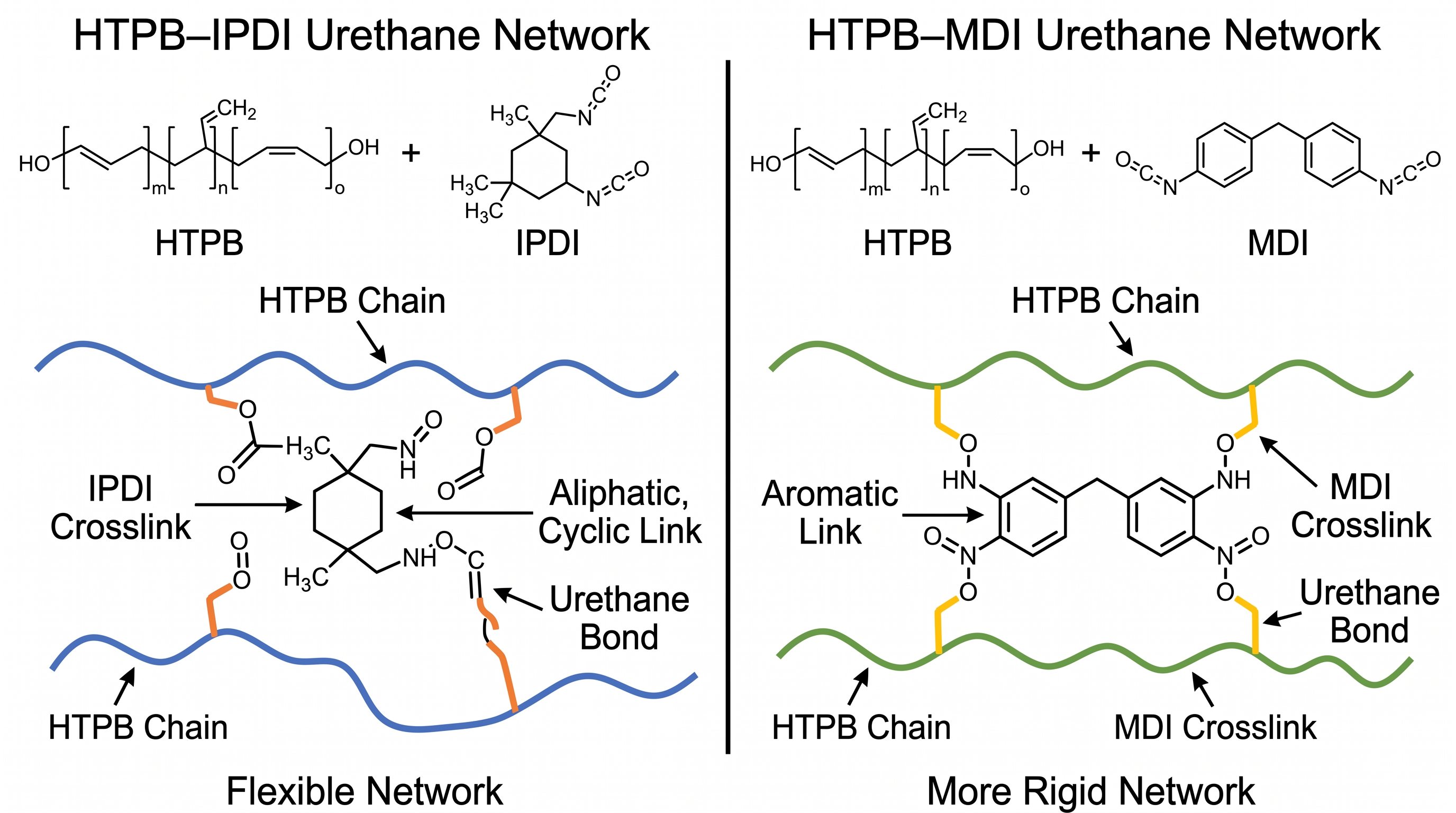
Figure 3. Comparison of HTPB-IPDI and HTPB-MDI network
Plasticizer

Andd, here is how plasticizer looks li… wait, sorry, wrong image.
But, the functionality is similar, like the name, plasticizer simply would make your propellant flowable. Another important material is plasticizer. Plasticizer, unlike IPDI or MDI. Plasticizers are not supposed to cross-link the HTPB, they are mostly physical members of the binder phase. They lower the liquid-phase viscousity, make the particle flowable (flow easier, I mean), reduce stiffness, and improve low-temp mobility by lowering the effective glass-transition behavior. DOS is well known for low-temperature flexibility, while IDP is also widely used with HTPB systems. [7]
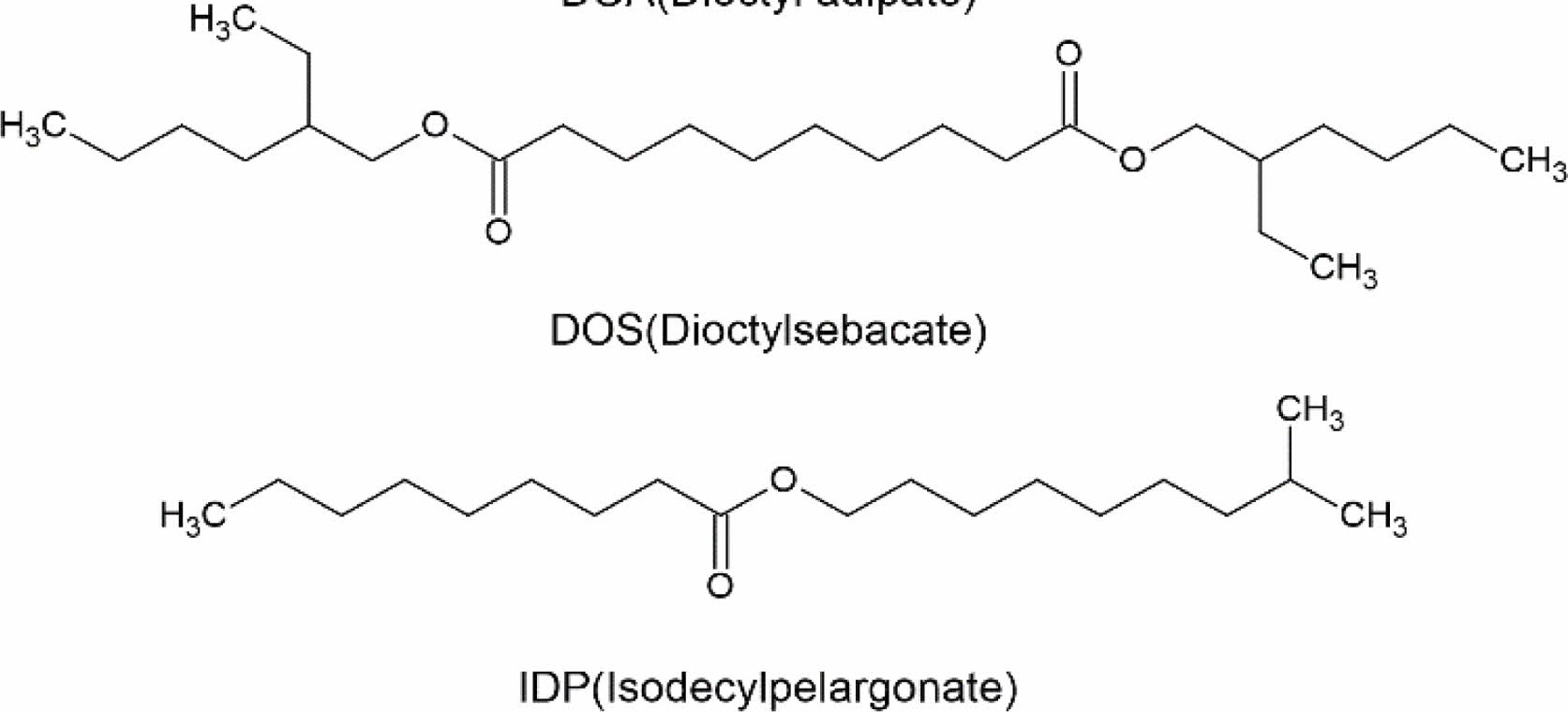
Figure 4. DOS and IDP structure
IDP here means isodecyl pelargonate. DOS means bis(2-ethylhexyl) sebacate, often called dioctyl sebacate. Both are ester plasticizers. Their simplified molecular formulas are:
During combustion they do matter, because their carbon, hydrogen, and oxygen join the reacting element pool. However, the mass fraction is usually small enough that writing a separate “plasticizer reaction” gives a false sense of precision. A thermochemical solver should include their elemental formula and enthalpy of formation. A hand explanation can simply say that they pyrolyze with the binder and become part of the hydrocarbon fuel stream.
There is also an engineering penalty. A non-energetic plasticizer can improve processability and mechanics while diluting energy per unit mass. It can migrate during aging, change bondlines, or affect long-term mechanical properties. So the plasticizer absolutely matters to the propellant, just not because it is the star of the AP–Al redox reaction.
Aluminum, the Metal Fuel
Aluminum is the metal fuel in the propellant. Unlike HTPB or the plasticizers, which primarily form the organic fuel and binder phase, aluminum is introduced as a solid metallic powder. Its main purpose is energetic: during combustion, aluminum is oxidized and releases a large amount of heat. This raises the flame temperature and increases the energy available to the expanding combustion products.
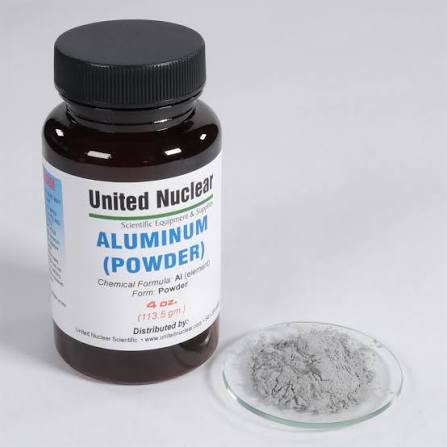
Figure 5. Aluminum powder
The overall oxidation is often represented in simplified form as:
This equation is useful for understanding aluminum’s role, although the actual environment inside an ammonium-perchlorate composite propellant is considerably more complicated. Free molecular oxygen is not the only oxidizing species available. AP decomposition produces oxygen-containing gases and reactive intermediates, and aluminum can react through a sequence of heterogeneous and gas-phase processes before eventually forming predominantly aluminum oxide, .
Fresh aluminum powder is also not truly bare aluminum. Each particle normally carries a thin native aluminum-oxide shell. During heating, the particle temperature rises, the oxide shell changes mechanically and chemically, and the underlying metallic aluminum eventually becomes available for rapid oxidation. Consequently, aluminum combustion does not necessarily occur at exactly the same location or time as decomposition of the surrounding AP and HTPB binder.
This delay is important. Near the burning propellant surface, AP decomposes and the polymeric binder pyrolyzes, producing oxidizer-rich and fuel-rich gases. These gases mix and react above the surface, while the aluminum particles are heated within this high-temperature environment. Once sufficiently heated, aluminum oxidation accelerates strongly and contributes additional heat farther away from the immediate surface.
In a conceptual reaction sequence:
while, in parallel,
The last equation should therefore not be interpreted as an isolated reaction pathway. Aluminum combustion is coupled to the surrounding AP–binder flame structure.
One particularly important phenomenon is aluminum agglomeration. Individual aluminum particles can accumulate and merge near the burning propellant surface, producing droplets or agglomerates considerably larger than the original particles. Larger agglomerates require more time to burn. Consequently, some aluminum may continue burning downstream inside the combustion chamber or even toward the nozzle rather than releasing all of its energy immediately at the propellant surface.
This behavior creates an important engineering trade-off. Aluminum can significantly increase the volumetric energy density of the propellant and raise combustion temperatures, but its oxidation product, , is largely condensed rather than gaseous. The resulting molten or solid oxide droplets are accelerated through the nozzle together with the gas products.
Therefore, although aluminum provides substantial chemical heat release, not all of that additional energy translates directly into ideal exhaust performance. The condensed particles introduce two-phase-flow losses because they cannot always accelerate and thermally equilibrate with the gas as efficiently as gaseous combustion products. Aluminum oxide can also deposit as slag inside the motor or nozzle region.
This distinction is useful when interpreting thermochemical calculations. A solver should not simply treat aluminum as though it were another gaseous hydrocarbon fuel. The equilibrium product mixture may contain condensed , and whether condensed products are assumed to remain in equilibrium with the gas or progressively separate during nozzle expansion can influence the calculated specific impulse.
Aluminum therefore serves several interconnected purposes in an AP/HTPB composite propellant:
- It acts as a high-energy metal fuel.
- Its oxidation contributes substantial heat to the combustion products.
- It increases propellant density and therefore improves volumetric energy loading.
- It raises flame and chamber temperatures.
- Its condensed products introduce particle-flow and nozzle-performance penalties.
- Its particle size and agglomeration behavior influence how completely and where the aluminum burns.
So aluminum is much closer to being one of the principal energetic ingredients than the plasticizer or curing agent. AP supplies most of the oxidizing capability, the HTPB-based binder supplies an important hydrocarbon fuel component, and aluminum supplies an additional high-energy metallic fuel component. The final propellant behavior comes from the interaction of all three rather than from one single global reaction.
The Mixture
Okk now, I’ll pretend you understand all of those things and remember all of the information. Let’s move on to “How are those materials actually mixing? How much of each one?” Basically, there is no single magical APCP composition. The formulation depends on what the motor is supposed to do. A booster designed for very high thrust, a smaller upper-stage motor, a tactical motor, and an experimental research motor can all use the same general AP/Al/HTPB family while having significantly different formulations. Here is the “quality”
Table 2. The quality composition for each materials.
| Ingredient | Typical relative amount | Functionalities |
|---|---|---|
| AP | Largest fraction | Main oxidizer and a major solid loading component |
| Aluminum | Significant solid fraction, when used | Metal fuel and additional heat release |
| HTPB-based binder phase | Much smaller than the solids, but structurally essential | Holds everything together and also contributes fuel |
| Plasticizer | Small fraction of the binder phase | Controls viscosity, flexibility, and processability |
| Curative | Small fraction | Builds the polyurethane network |
| Catalysts / bonding agents / other additives | Usually very small | Fine-tune burning, cure, adhesion, aging, and processing |
For example, cherry limeade is made from:
| Ingredient | Percentage |
|---|---|
| HTPB | 10.993% |
| IDP | 4.275% |
| MDI | 1.942% |
| Castor Oil (I didn’t mentioned this) | 0.3% |
| PDMS (this too) | 0.05% |
| Triton X100 (this too) | 0.05% |
| Al | 7.5% |
| 200 AP | 65.5% |
| 90 AP | 9.5% |
On the other hand, SRB contains,
| Ingredient | Percentage |
|---|---|
| PBAN (binder) | 13% |
| DER 331 ECA (the curing agent) | 1.96% |
| Iron Oxide | 0.5% |
| 15 Al | 16% |
| 200 AP | 49% |
| 20 AP | 21% |
As you can see, different rocket motors use different chemical compound and different percentages for each material. So, there’s no single global rule for that. And if you notice, PBAN used as binder here in SRB with its couple is DER 331 ECA, ECA means: epoxy curing agent. So, SRB didn’t use IPDI or MDI because IPDI and MDI are specifically for HTPB.
References
- NASA, “The Space Shuttle” — public SRB composition and production overview. Open source
- NASA, “Space Launch System Solid Rocket Booster” and SLS reference material — PBAN heritage and booster context. Open source
- NASA Glenn, “Chemical Equilibrium with Applications” — scope of CEA and links to RP-1311. Open source
- NASA CEA documentation, “Theory” — Gibbs-energy minimization and element conservation. Open source
- Sekkar, V. and Raunija, T. S. K., “Issues Related with Pot Life Extension for HTPB-Based Solid Propellant Binder System,” Propellants, Explosives, Pyrotechnics 40 (2015). Open source
- Ma, H. et al., “The Effect of Single Curing Agents on the Curing Reactions of the HTPB-Based Binder System,” Coatings 12, 1090 (2022). Open source
- NIST Chemistry WebBook, ammonium perchlorate thermochemistry. Open source
- NIST-JANAF Thermochemical Tables, standard-state data for the worked example. Open source
- Yan, X. et al., “Mechanism of Interaction between Ammonium Perchlorate and Aluminum,” Journal of Physical Chemistry A 127 (2023). Open source
- Review of AP chemistry in AP/HTPB gas-phase kinetic mechanisms, Progress in Energy and Combustion Science (2024). Open source
- Landers, L. C., Stanley, C. B., and Ricks, D. W., “Propellant development for the Advanced Solid Rocket Motor,” NASA NTRS (1991). Open source
- Richard Nakka’s Experimental Rocketry Site, public index entry for the Cherry Limeade formulation. Used only to identify the commonly cited ingredient system. Open source